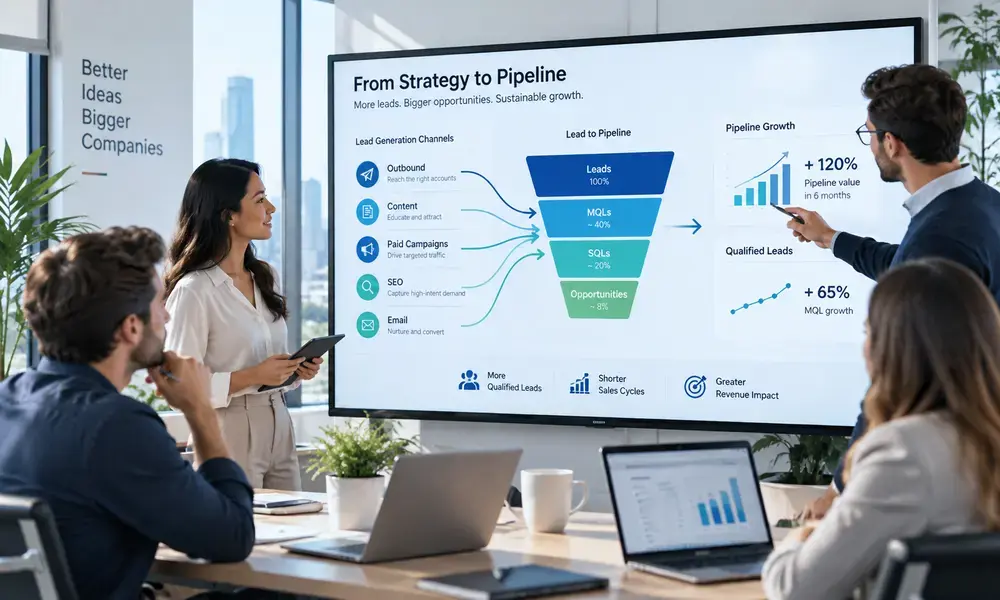
SaaS Lead Generation Strategies That Build Pipeline
Cecily Brooks. Last updated September 2026.
SaaS lead generation strategies work best when they connect a defined buyer group to a clear next step. B2B SaaS teams can combine cold email, LinkedIn outreach, cold calling, SEO, paid marketing, inbound content, sales enablement, and appointment setting. The right mix depends on the market, offer, sales process, and internal capacity.
Key points
- SaaS lead generation differs from many other B2B programs because the buyer must understand an ongoing product relationship, not a one-time
- Choose B2B SaaS lead generation strategies by matching the channel to buyer intent, deal complexity, and team capacity.
- The first lead generation methods for SaaS should usually include targeted email, LinkedIn outreach, useful search content, paid marketing
- A SaaS lead generation funnel should include audience selection, a relevant first touch, a useful response path, qualification, sales
Lead generation is not a single campaign. It is a system for finding likely buyers, starting relevant conversations, and giving sales enough context to act. A visitor who downloads a guide is not the same as a decision-maker asking for a product discussion. Your process should separate those signals.
This guide explains the main lead generation methods for SaaS, how to choose channels, what a platform should do. How to check whether activity is creating useful pipeline.
What makes SaaS lead generation different?
SaaS lead generation differs from many other B2B programs because the buyer must understand an ongoing product relationship, not a one-time purchase. The decision may involve users, technical reviewers, finance teams, and senior leaders. Your messaging must show the business problem, product fit, expected buying path, and reason to act now without making claims you cannot support.
A SaaS team also has more than one useful conversion. A product tour, pricing visit, reply, meeting request, content download, or referral may show interest at a different stage. Treating every action as a sales-ready lead creates poor handoffs.
Start with the buying group. Write down:
- The company type you want to reach.
- The role that feels the problem first.
- The person who approves the purchase.
- The event that suggests active interest.
- The evidence sales needs before outreach.
A focused profile is more useful than a large contact list. It gives the team a shared standard for account selection and message quality.
How do you choose B2B SaaS lead generation strategies?
Choose B2B SaaS lead generation strategies by matching the channel to buyer intent, deal complexity, and team capacity. Use outbound methods to create targeted conversations, inbound methods to capture existing interest, and sales enablement to improve follow-up. Test one clear audience and offer before expanding to more channels.
Begin with the sales motion. A product with a focused buyer group may suit account-based outreach. A broader product may need search content, paid campaigns, or educational resources that capture several use cases. A sales team with limited time may need fewer channels and tighter qualification.
Use a simple channel scorecard. Rate each option against:
- Access: Can your team reach the right people?
- Relevance: Can you explain a problem the buyer recognises?
- Speed: How quickly can the channel produce useful learning?
- Cost: What staff time, media spend, and tools does it require?
- Handoff: Can sales act on the response?
Do not judge a channel by activity alone. A large number of clicks or contacts does not prove fit. Track whether the source produces replies, qualified conversations, appointments, and sales opportunities.
A small test is easier to improve. Pick one audience, one problem, one offer, and one follow-up path. Set a review date before launch. Change one major variable at a time so the team can identify what affected the result.
Which lead generation methods for SaaS should teams test first?
The first lead generation methods for SaaS should usually include targeted email, LinkedIn outreach, useful search content, paid marketing where the audience is clear. A defined calling or appointment process. Test the methods that match your buyers and sales motion rather than copying another company’s channel mix.
Cold email
Cold email works best when the message has a clear reason for contact. Start with a narrow audience and a specific business issue. Keep the first message easy to scan. State why the recipient was selected, what problem you address, and what small next step you suggest.
Avoid sending the same copy to every role. A finance leader may care about control or planning. A team manager may care about workflow or adoption. The product may be the same, but the business context differs.
LinkedIn outreach
LinkedIn can support account research, direct messages, and useful public content. The first interaction does not need to be a pitch. A relevant observation or clear question can create a better opening than a long product description.
Keep outreach tied to a defined account list. Record the reason for contact and the response. If a person shows interest, sales should know which message, topic, or resource created that signal.
Cold calling and appointment setting
Calling adds a direct route to a conversation. It can also expose objections that written messages miss. Use a short opening, explain the reason for the call, and ask whether the issue is relevant. Appointment setting should confirm the topic, people attending, and intended outcome.
SEO and inbound marketing
SEO attracts people who search for answers, comparisons, processes, and product categories. A useful page should answer the search clearly before asking for contact details. Add a relevant next step, such as a guide, consultation request, or product conversation.
Inbound content needs a sales path. A page can attract traffic but fail to create opportunities if the offer is unclear or the follow-up is slow. Connect each important page to a sensible action.
Paid marketing
Paid campaigns can test demand and message fit with a defined audience. Give each campaign one job. A campaign for awareness should not use the same measure as a campaign designed to produce appointments. Check the lead source and qualification before increasing spend.
What should a SaaS lead generation funnel include?
A SaaS lead generation funnel should include audience selection, a relevant first touch, a useful response path, qualification, sales follow-up, and pipeline review. Each stage needs a clear owner. The funnel should show where interest begins, where it becomes a conversation, and where poor fit or weak follow-up removes momentum.
1. Audience and account selection
Create an account list or audience definition before writing copy. Include the roles involved in the problem and the buying decision. Note company traits, use cases, known triggers, and exclusions. A clear list reduces random activity.
2. First signal
The signal may be a search, content visit, reply, direct inquiry, social interaction, or response to outreach. Record the signal and its source. The team needs enough context to decide whether the next step is education, qualification, or a sales conversation.
3. Offer and response path
Give the buyer one clear action. That action could be replying to an email, booking an appointment, requesting information, or reviewing a focused resource. Remove extra choices when the goal is a meeting.
4. Qualification
Qualification should test fit and timing without turning the first conversation into an interrogation. Confirm the problem, affected team, current process, desired change, and people involved in the decision. Capture useful notes for the next meeting.
5. Handoff and follow-up
Set a response owner and a follow-up rule. A qualified inquiry should not sit in a shared inbox with no clear next step. Sales enablement can provide message guides, objection notes, call structure, and account context.
6. Pipeline review
Review sources by opportunity quality, not lead volume alone. Ask which accounts moved forward, which messages earned replies, and where prospects stopped responding. The answers should change targeting, content, follow-up, or qualification.
What should a lead generation platform for SaaS do?
A lead generation platform for SaaS should help teams identify target accounts, manage outreach, capture inbound responses, record source data, and support sales follow-up. It should make work easier to inspect. If the system cannot show why a person entered the process or what happened next, reporting will be weak.
The platform does not replace judgment. It should organise work so the team can make better decisions. Look for functions that support the full path from first signal to opportunity.
Useful capabilities include:
- Contact and account records.
- Campaign and message tracking.
- Source and response history.
- Task ownership for follow-up.
- Appointment details.
- Notes from calls and conversations.
- Pipeline stages.
- Basic reporting by channel and audience.
Data quality matters more than a crowded feature list. A system with missing roles, stale records, or unclear ownership will slow sales. Set rules for naming, field updates, duplicate handling, and handoff before the team adds more campaigns.
Check the reporting view with real questions. Can you find which campaign produced a qualified opportunity? Can a salesperson see the last interaction before a call? Can a manager identify accounts that need follow-up? If the answer is no, the process needs attention.
How can teams build a reliable outbound program?
Teams build a reliable outbound program by narrowing the audience, using a clear reason for contact, testing relevant messages, and setting a consistent follow-up process. Quality controls matter. Check account fit, contact role, message accuracy, sending practices, and response handling before increasing volume.
Start with research that sales can use. Identify the business issue, the likely role, and the event that makes the issue more urgent. Avoid personal details that do not support the business reason for contact.
A practical sequence may include:
- Define the account group.
- Select the roles involved.
- Write one problem-led message.
- Add a simple reply or meeting option.
- Plan follow-up for non-responses.
- Record every response and disposition.
Message testing should focus on one change at a time. You might test the opening problem, call to action, role angle, or proof point. Keep the audience stable while testing. A new audience and new message make the result hard to interpret.
Poor outbound programs usually fail in familiar ways. The list is too broad. The copy speaks about features before the buyer’s problem. The call to action demands too much. Replies reach a team that does not know who owns them. Fix the process before sending more messages.
How should SaaS teams use SEO and inbound content?
SaaS teams should use SEO and inbound content to answer buyer questions at different stages of research. Build pages around real problems, product categories, comparisons, and implementation concerns. Each page needs a clear audience, a useful answer, and a next step that fits the reader’s intent.
Start with topics sales hears in calls. Questions about setup, switching tools, reporting, security, workflow, or team use can reveal strong content opportunities. Write a direct answer near the top, then add detail for readers who need it.
A useful content plan can include:
- Problem pages for early research.
- Comparison pages for active evaluation.
- Process guides for implementation concerns.
- Use-case pages for distinct buyer groups.
- Sales resources that support follow-up.
Review pages for clarity, search intent, internal paths, and conversion friction. Remove claims the business cannot support. Give readers a reason to continue, but do not force a sales form on every visit.
Inbound leads still need qualification. A content download may show interest in a topic, while a request for a product discussion shows a stronger buying signal. Use different follow-up paths for those actions.
What do B2B SaaS lead generation examples look like?
B2B SaaS lead generation examples are easiest to understand as connected plays rather than isolated tactics. Each example starts with a defined audience, uses a relevant message or resource, and gives sales a clear way to respond. The team then checks whether the activity created qualified conversations or only surface-level engagement.
Example: targeted outbound for one buyer group
A SaaS team selects a narrow group of decision-makers who share a clear operational problem. It uses cold email and LinkedIn outreach with separate messages for senior and day-to-day roles. Replies are routed to sales with the original message and account notes attached.
The team reviews reply quality, meeting fit, and repeated objections. If responses are weak, it checks the audience and problem statement before changing the entire channel.
Example: search content with a sales path
A company publishes a page that answers a practical question from buyers who are researching a solution. The page explains the process in plain language and offers a relevant next step. Sales receives requests with the page topic attached.
The team studies which topics lead to useful conversations. It can then create related content for adjacent questions or improve the handoff for high-intent visitors.
Example: content plus appointment setting
A campaign uses an educational resource to attract a defined audience. Interested contacts receive a follow-up that offers a focused appointment. The meeting invitation states what the discussion will cover and who should attend.
This approach works only when the appointment has a clear purpose. A vague meeting request creates confusion and weakens the next sales step.
Example: multi-channel account outreach
A sales team combines email, LinkedIn, calling, and sales enablement for selected accounts. Each touch has a different purpose. One may introduce the issue, another may share useful context, and a call may confirm relevance.
The team records activity in one place. That prevents repeated messages and gives sales a clearer view of account engagement.
How do you measure lead generation performance?
Measure lead generation performance by tracking progress from source to qualified opportunity. Start with volume, but do not stop there. Compare audience fit, response quality, appointments, opportunity creation, and pipeline movement by channel. The purpose of reporting is to decide what to keep, change, or stop.
A basic review can include:
- Contacts reached.
- Responses received.
- Qualified conversations.
- Appointments set.
- Appointments held.
- Opportunities created.
- Pipeline stage movement.
- Reasons for rejection or loss.
The exact measures depend on the sales process. A long buying cycle needs stage tracking and follow-up discipline. A shorter cycle may allow faster message tests. Use the measures that reflect how buyers move through your process.
Source data must remain consistent. Name campaigns in a standard way. Record the original source and the latest touch. Keep lead status definitions short enough that every salesperson can apply them the same way.
A high activity level with no qualified opportunities points to a problem. The issue may be poor targeting, weak positioning, low-intent traffic, unclear qualification, or slow follow-up. Do not assume the answer is more volume.
How can a SaaS sales team improve lead quality?
A SaaS sales team improves lead quality by defining fit before launch, using signals in outreach, asking focused discovery questions, and feeding sales insight back into marketing. Quality improves when the team agrees on what counts as a useful opportunity and removes sources that repeatedly create poor matches.
Write an acceptance standard in plain language. Include the customer type, relevant problem, decision role, and next action. Share it with marketing, sales development, account executives, and anyone who manages campaigns.
Use feedback from real conversations. Sales calls reveal unclear terms, missing content, weak offers, and objections. Marketing can turn those findings into better pages and messages. Sales enablement can turn them into call guides and follow-up material.
Do not treat every rejection as a failed lead source. Some contacts are good fits at the wrong time. Record the reason. A future follow-up path may be suitable, while a poor account fit should leave the active program.
Strong qualification also protects the buyer’s time. A person should not enter a sales sequence only because they downloaded an unrelated resource. Match the follow-up to the action and the likely level of intent.
When should a SaaS company use an outside lead generation service?
A SaaS company should use an outside lead generation service when it needs added execution capacity, specialist support, or a structured test across outreach and inbound channels. The company should still own its audience, offer, qualification standard, and sales goals. A partner works best with clear access, feedback, and handoff rules.
Before choosing a provider, define the work needed. It may include cold email, LinkedIn outreach, cold calling, inbound lead generation, SEO, paid marketing, sales enablement, or appointment setting. These services require different inputs and review methods.
Ask how the program will handle:
- Target account selection.
- Message approval.
- Contact and source records.
- Response ownership.
- Appointment quality.
- Sales feedback.
- Reporting and review points.
A provider should be able to explain the work in terms of buyer fit and qualified opportunities. Be cautious of a plan that promises activity without defining the outcome or handoff.
Vitalsoft Tech provides signal-driven B2B SaaS lead generation through multi-channel outreach and inbound marketing. Its services include cold email, LinkedIn outreach, cold calling, inbound lead generation, SEO, paid marketing, sales enablement, and appointment setting. The company focuses on reaching SaaS decision-makers, creating qualified opportunities, and building sales pipelines.
A practical 30-day plan for SaaS lead generation
A focused first month can create useful evidence without launching every channel at once. The goal is to build a repeatable process and learn where buyer interest appears.
Week one: define the market
Choose one buyer group and write its problem in plain language. List the roles involved, the account traits that matter, and the signal that suggests interest. Set the qualification standard before outreach begins.
Week two: prepare assets
Write one outbound message and one follow-up path. Create or select a useful inbound resource if the plan includes content. Prepare sales notes, response rules, appointment details, and a source field for reporting.
Week three: run a controlled test
Launch with a manageable account group. Watch for wrong contacts, unclear messages, poor-fit replies, and handoff delays. Keep notes as the test runs. These details are more useful than memory at the review stage.
Week four: inspect and decide
Compare activity with qualified conversations and opportunity movement. Keep what produced useful signals. Change one weak part of the process. Stop sources that repeatedly produce poor fit. Set the next test around a specific question, such as whether a different role or problem statement improves response quality.
A month will not answer every strategic question. It can show whether the audience, message, process, and handoff are clear enough to support a larger program.
Frequently asked questions
What is SaaS lead generation?
SaaS lead generation is the process of finding potential software buyers, creating relevant interest, and moving suitable contacts toward a sales conversation. It can include outbound outreach, SEO, inbound marketing, paid campaigns, calling, appointment setting, and sales follow-up.
Which channel is best for B2B SaaS?
No single channel is best for every B2B SaaS company. The right choice depends on the buyer, sales motion, offer, and team capacity. Targeted outbound may suit a focused market, while SEO or paid marketing may suit buyers who actively research a problem.
How do I generate better SaaS leads?
Define the target account and buying role first. Use a message tied to a real problem, record the source, qualify the response, and review opportunity quality. Better leads come from a tighter fit between audience, offer, timing, and sales follow-up.
Should SaaS companies use a lead generation platform?
A SaaS company should use a platform when it needs shared records, campaign tracking, source reporting, task ownership, and pipeline visibility. The tool should support the process. It cannot fix unclear targeting, weak messages, poor data, or missing follow-up rules.
What does a SaaS lead generation service include?
A SaaS lead generation service may include cold email, LinkedIn outreach, cold calling, inbound lead generation, SEO, paid marketing, sales enablement, and appointment setting. The service should connect these activities to qualified opportunities and a clear sales handoff.