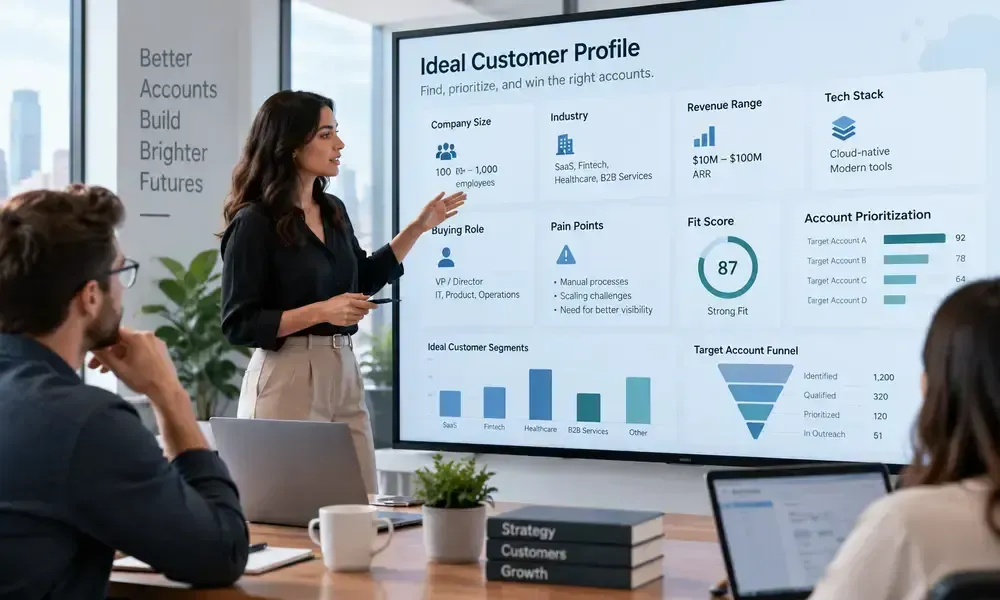
B2B SaaS Ideal Customer Profile: A Practical Guide
By Cecily Brooks. Last updated September 2026.
A B2B SaaS ideal customer profile gives your team a shared picture of the accounts it should pursue. It describes company traits, business needs, buying conditions, and signs of likely success. The profile is broader than a buyer persona, which focuses on an individual decision-maker.
Key points
- A B2B SaaS ideal customer profile is a description of the company that receives the most value from a SaaS product and has a strong reason
- An ICP gives growth teams a common filter for deciding where to spend effort.
- Research an ICP by comparing your best current accounts with poor-fit accounts.
- An ICP should include the account traits that affect fit, urgency, buying ability, and successful use.
A useful profile keeps marketing, sales, and customer success focused on the same market. It also gives teams a clear reason to reject poor-fit opportunities. That matters when a company has limited time, budget, or sales capacity.
This guide explains how to research an ICP, score accounts, improve the sales experience, and connect customer feedback to future growth.
What is a B2B SaaS ideal customer profile?
A B2B SaaS ideal customer profile is a description of the company that receives the most value from a SaaS product and has a strong reason to buy it. It covers firm size, industry, location, systems, business problems, buying authority, budget signals, and likely retention factors.
The profile should describe an account, not a person. A SaaS finance platform may serve a controller, but its ICP could be a growing company with a finance team that needs better reporting. The controller is a buyer. The company is the account.
A strong ICP answers four practical questions:
- Which companies have the problem?
- Which companies can act on it?
- Which companies can buy the product?
- Which companies are likely to see value after purchase?
Avoid vague language such as “modern businesses” or “teams that need efficiency.” Name the operating conditions that make the problem urgent. For example, a profile might focus on SaaS companies with several revenue teams, a defined sales process, and a need to bring data into one system.
The profile is a working business tool. It should change when win-loss reviews, customer feedback, and sales results show a new pattern.
Why does an ICP matter for SaaS growth?
An ICP gives growth teams a common filter for deciding where to spend effort. It can improve message relevance, lead research, sales qualification, onboarding plans, and account reviews. The value comes from better choices, not from the document itself.
Without an ICP, teams may chase accounts that look attractive but lack a clear need. Marketing may create broad campaigns. Sales may accept deals that require heavy custom work. Customer success may inherit accounts that never had a good product fit.
A practical ICP supports decisions such as:
- Which industries deserve a campaign.
- Which accounts should receive personal outreach.
- Which leads need more research before a meeting.
- Which customers need a different onboarding path.
- Which objections should shape sales content.
It also creates a useful handoff between teams. Marketing can describe the target account. Sales can test the fit during discovery. Customer success can check whether the promised outcome is being reached.
An ICP does not replace judgment. A company outside the profile may still become a good customer. The profile sets a priority, not an absolute rule.
How do you research an ideal customer profile?
Research an ICP by comparing your best current accounts with poor-fit accounts. Review sales notes, product use, renewal history, support themes, lost deals, and customer interviews. Look for repeated business conditions rather than isolated details from one enthusiastic buyer.
Start with a small sample that your team can examine closely. Group accounts by useful facts, such as:
- Industry and business model.
- Company size and team structure.
- Main use case.
- Existing tools.
- Buying trigger.
- Time from first contact to decision.
- Onboarding effort.
- Product adoption.
Then compare patterns. Strong-fit accounts may share a clear use case and an internal owner. Poor-fit accounts may need features your product does not provide or may lack the staff needed to put the software into use.
Talk to people across the account journey. A salesperson can explain the buying trigger. A customer success manager can describe adoption barriers. A product team member can identify the use cases that produce the clearest value.
Customer interviews should stay specific. Ask what happened before the purchase, what changed the buying decision, which alternatives were considered, and what made implementation easier or harder. Avoid asking only whether the customer “likes” the product. Opinions matter, but behavior gives stronger evidence.
Record evidence in a shared table. Add a source for each pattern. Mark uncertain points as hypotheses until more accounts support them.
What information should an ICP include?
An ICP should include the account traits that affect fit, urgency, buying ability, and successful use. Keep the fields practical. If a field never changes targeting, qualification, messaging, or service, remove it.
Useful sections include:
Company details
Record industry, business model, location, employee range, revenue model, growth stage, and team structure. Choose ranges that your team can apply consistently. Avoid false precision when the data does not support it.
Operating environment
List the systems, processes, and roles connected to the problem. A prospect may have a sales team, several data sources, and a process that still relies on manual work. Those details explain why the problem exists.
Business problem
Describe the issue in the customer’s language. “Poor visibility” is broad. “Managers cannot see pipeline changes before the weekly review” is easier to test.
Buying signals
Note events that can create urgency. These might include a new leader, a team expansion, a system change, a missed target, or a new reporting requirement. Treat these as research points unless you have evidence that they predict a purchase.
Success conditions
State what must be true after the sale. The account may need an internal owner, a clear workflow, enough users, or time for implementation. These conditions connect the ICP to B2B SaaS customer success.
Exclusion criteria
Define poor-fit signs. An account may lack the required system, need unsupported work, or expect a service model your company does not offer. Exclusions protect sales time and reduce avoidable disappointment.
How should SaaS teams score and segment accounts?
SaaS teams should score accounts against a short set of evidence-based criteria. A simple scale works best when every score has a written meaning. Combine firmographic fit with problem urgency, buying readiness, and the conditions needed for successful adoption.
For example, a team might score each area from zero to four:
- Account fit: Does the company match the target market?
- Problem fit: Does it have the problem the product solves?
- Readiness: Is there a reason to act now?
- Buying access: Can the team reach the people involved in the decision?
- Success fit: Can the account use and support the product?
Write the evidence beside each score. “Good fit” is not enough. “Has a sales operations owner and reviews pipeline weekly” gives the next person something to check.
Segment accounts by action, not by score alone. A high-fit account with no active project may need education. A lower-fit account with urgent pain may need a careful qualification call. A strong-fit account with a clear trigger may deserve direct sales attention.
Review the scoring model after deals move through the funnel. If high-scoring accounts rarely progress, the model may reward easy-to-find traits instead of buying conditions. If low-scoring accounts close and adopt well, the profile may be too narrow.
Keep the model light enough for daily use. A complex worksheet that salespeople avoid is less useful than a short score with reliable notes.
How can an ICP improve B2B SaaS lead generation tips?
An ICP improves lead generation by giving campaigns a clear audience and a concrete problem to address. It helps a team choose accounts, channels, messages, and calls to action with less guesswork. The best campaign starts with the customer condition, not with a list of product features.
These B2B SaaS lead generation tips follow from the profile:
- Build account lists around fit signals, not company names alone.
- Write outreach around a known business problem.
- Separate active buying signals from basic company data.
- Create different messages for different use cases.
- Track which account types produce qualified conversations.
Cold email may suit a segment with a clear problem and a reachable business role. LinkedIn outreach may support account research and familiarisation. Cold calling can test urgency through direct conversation. Inbound lead generation can attract buyers who are already researching a problem. SEO and paid marketing can support different stages of that research.
Each channel needs its own test. Do not assume that one message or offer will work across every segment. A campaign aimed at operations leaders should speak to operating pain. A campaign aimed at finance leaders should focus on financial control or reporting only if the product addresses that need.
Measure quality after the lead arrives. A meeting is not automatically a good result. Check account fit, problem clarity, buying access, and the likely path to value.
Vitalsoft Tech provides signal-driven B2B SaaS lead generation through multi-channel outreach and inbound marketing. Its services include cold email, LinkedIn outreach, cold calling, inbound lead generation, SEO, paid marketing, sales enablement, and appointment setting.
What should sales teams do with an ICP?
Sales teams should use the ICP to prepare, qualify, and personalise conversations. It should guide research before outreach and provide a fair reason to pause an opportunity. The document should support discovery rather than turn discovery into a script.
Before a call, review the account against the profile. Note the likely problem, possible trigger, relevant team, and missing evidence. Bring a few hypotheses. Do not present them as facts.
During discovery, test four areas:
- The current process.
- The cost or risk of the problem.
- The people affected by it.
- The change the buyer wants.
Listen for gaps between the account’s stated goal and its ability to act. A buyer may want a new system but lack an owner, implementation time, or agreement across teams. Those gaps do not always end the opportunity. They do change the next step.
A useful sales experience feels relevant and controlled. The prospect should understand why the conversation matters, what the seller heard, and what will happen next. Avoid forcing every account through the same sequence when the evidence points to a different path.
B2B SaaS sales experience improves when marketing and sales share definitions. Agree on what counts as a target account, a qualified opportunity, and a poor fit. Review these definitions in pipeline meetings instead of treating them as fixed language.
Sales enablement should turn the ICP into usable tools. Create discovery prompts, objection notes, account research fields, and examples of strong and weak fit. Keep the tools close to the workflow.
How can customer success use the ICP after a sale?
Customer success can use the ICP to plan onboarding, identify adoption risks, set account expectations, and spot patterns across customers. The team should compare each new account with the success conditions in the profile, then adapt the plan when the account differs.
A customer that matches the profile may still need a clear owner and a defined first use case. Confirm those points early. Ask who will use the product, what process will change, and how the account will judge progress.
The ICP can support customer success work in several ways:
- Onboarding: Start with the workflow linked to the buying reason.
- Training: Focus sessions on the roles that need to act.
- Risk review: Watch for missing owners, low use, or unclear goals.
- Expansion research: Look for related needs only after the first outcome is clear.
- Internal feedback: Record where the profile predicted success or missed a barrier.
Do not use the ICP to assume that every customer needs the same service. Two accounts may share an industry but have different processes. Their plans should reflect the evidence gathered after purchase.
Customer success can also improve the profile. Add notes from onboarding calls, support conversations, adoption reviews, and renewal discussions. A profile that stops after the sale will miss some of the clearest evidence about fit.
How should teams run B2B SaaS surveys customer feedback?
Teams should run B2B SaaS surveys customer feedback at points where the customer can answer from experience. Keep each survey focused on one decision. Ask about a recent event, the outcome reached, the barrier faced, or the next need rather than asking for broad praise.
A useful survey may examine:
- Why the customer chose the product.
- Whether the original problem changed.
- Which feature or workflow is used.
- What blocked wider use.
- What support would improve progress.
Use survey results with account data. A positive answer does not prove strong adoption. A negative answer may reflect poor onboarding, a missing feature, or a problem outside the product. Read the response beside usage notes, support themes, and the account’s stated goal.
Open-text answers deserve careful review. Group comments by topic, account type, use case, and stage. Do not treat one striking comment as a market-wide truth. Mark it as a signal that needs checking.
Close the loop with customers when a response leads to a conversation or change in the account plan. People give better feedback when they see that the business reads it and acts on it.
The same approach applies to B2B SaaS surveys customer satisfaction. Ask a clear question, define the time period, record the segment, and separate satisfaction from product fit. A customer may be satisfied with support while still lacking a strong use case.
What mistakes weaken an ideal customer profile?
The most common mistake is describing an attractive market instead of a reachable, solvable one. A large industry label says little about urgency, buying access, or product use.
Other problems include:
- Treating one large deal as proof of broad fit.
- Copying assumptions from a competitor’s market.
- Using data that sales cannot verify.
- Ignoring accounts that churn or fail to adopt.
- Scoring every lead as a priority.
- Mixing buyer personas with account criteria.
- Keeping the profile hidden in one department.
A profile can also become too narrow. If it describes only current customers, it may exclude a new segment that shares the same problem and success conditions. Test adjacent segments with small campaigns before changing the whole model.
Watch for language that cannot guide action. “Innovative,” “fast-growing,” and “customer-focused” may sound useful, but they need evidence. Replace them with observable facts, such as a named process, team structure, system, or business trigger.
Review false positives and false negatives. A false positive looks like a good account but does not progress or adopt. A false negative seems outside the profile but produces strong results. Both cases can improve the next version.
How often should a SaaS company update its ICP?
A SaaS company should review its ICP on a regular operating rhythm and whenever market evidence changes. Review it after meaningful wins, repeated losses, shifts in product use, new sales patterns, or customer success findings. Update the profile only when evidence supports a change.
Set one owner for the document. That person gathers input from marketing, sales, product, and customer success. The owner should record what changed and why.
A review can cover:
- New high-fit accounts.
- Poor-fit wins and losses.
- Sales cycle obstacles.
- Onboarding delays.
- Support themes.
- Survey responses.
- Accounts that use the product in an unexpected way.
Keep old versions. They show whether a change improved targeting or only changed the wording. Compare the revised profile with pipeline quality, sales experience, adoption, and feedback from the affected segment.
The profile should be stable enough to guide work and flexible enough to reflect new evidence. Frequent edits based on a single opinion create confusion. No edits after a clear pattern appears create waste.
A practical ICP workflow for B2B SaaS teams
A team can build a useful first version without waiting for perfect data. Begin with the accounts that show the strongest combination of need, buying clarity, and product use.
Follow this workflow:
- Choose the comparison group. Include strong-fit accounts, poor-fit accounts, and recent lost opportunities.
- Collect evidence. Review sales notes, customer conversations, product use, support topics, and survey responses.
- Write observable traits. Describe company conditions, problems, triggers, roles, and success requirements.
- Set exclusions. List signs that suggest the account needs a different product or service path.
- Create a simple score. Define what each score means and require evidence beside it.
- Test the profile. Use it in a focused campaign, discovery process, or onboarding review.
- Compare results. Check account quality, opportunity movement, sales experience, and early customer outcomes.
- Revise the model. Keep useful signals, remove weak ones, and document the reason for each change.
Vitalsoft Tech focuses on reaching SaaS decision-makers, creating qualified opportunities, and building sales pipelines. If your team needs outside support for account targeting or multi-channel outreach, review your current ICP before choosing a campaign.
A clear profile will not solve every growth problem. It gives the team a better way to choose work, test assumptions, and learn from each account. That is its practical value.
Frequently asked questions
What is the difference between an ICP and a buyer persona?
An ICP describes the company most likely to benefit from and buy a SaaS product. A buyer persona describes an individual involved in the purchase, such as an executive, manager, or technical evaluator.
What should a SaaS ICP contain?
What should a SaaS ICP contain — it should contain account traits, operating conditions, business problems, buying signals, success requirements, and poor-fit signs. Each point should help marketing, sales, or customer success make a decision.
Can a small SaaS company build an ICP without much data?
Yes. Start with available sales notes, customer conversations, product use, support themes, and lost deals. Mark uncertain ideas as hypotheses and improve the profile as more accounts provide evidence.
How does an ICP support customer success?
How does an ICP support customer success — it shows the conditions linked to successful adoption. Customer success can use those conditions to plan onboarding, identify missing owners or goals, and compare new accounts with known adoption patterns.
Should every lead that matches the ICP become a sales opportunity?
No. Account fit is one part of qualification. The team should also confirm the problem, urgency, buying access, and ability to reach value.
Review your SaaS ICP before your next lead generation campaign